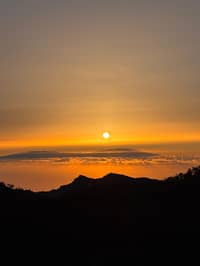
 Booked here
Guides
Language
EnglishCurrency
US dollar · $Your currency applies on GetYourGuide too.
Guide · The park after dark
Teide National Park stargazing after the day visitors leave
Teide National Park stargazing is free to anyone with a car and warm clothes. Here are the viewpoints, the rules that still apply after dark, and when a guide is worth it.
Check availabilityfrom $47 · no cancellation fee
Editorial team, tenerifestargazingtour.comUpdated October 23, 20266-minute read33 sources
Quick answer
The park once the visitor centers close
Teide is the largest and oldest national park in the Canary Islands and the most visited in Spain's national parks network.7 By day its car parks fill with coaches. By night the same caldera is almost empty, and the sky above it is the reason many people drive up at all.
The services are a daytime affair. The El Portillo visitor center opens from 9:00 to 16:15 and the Cañada Blanca center from 9:00 to 16:00, so after dark there is nobody at a desk to ask.8 The park covers 18,990 ha, which is a lot of dark ground to be in on your own, so plan the evening before you set off.9
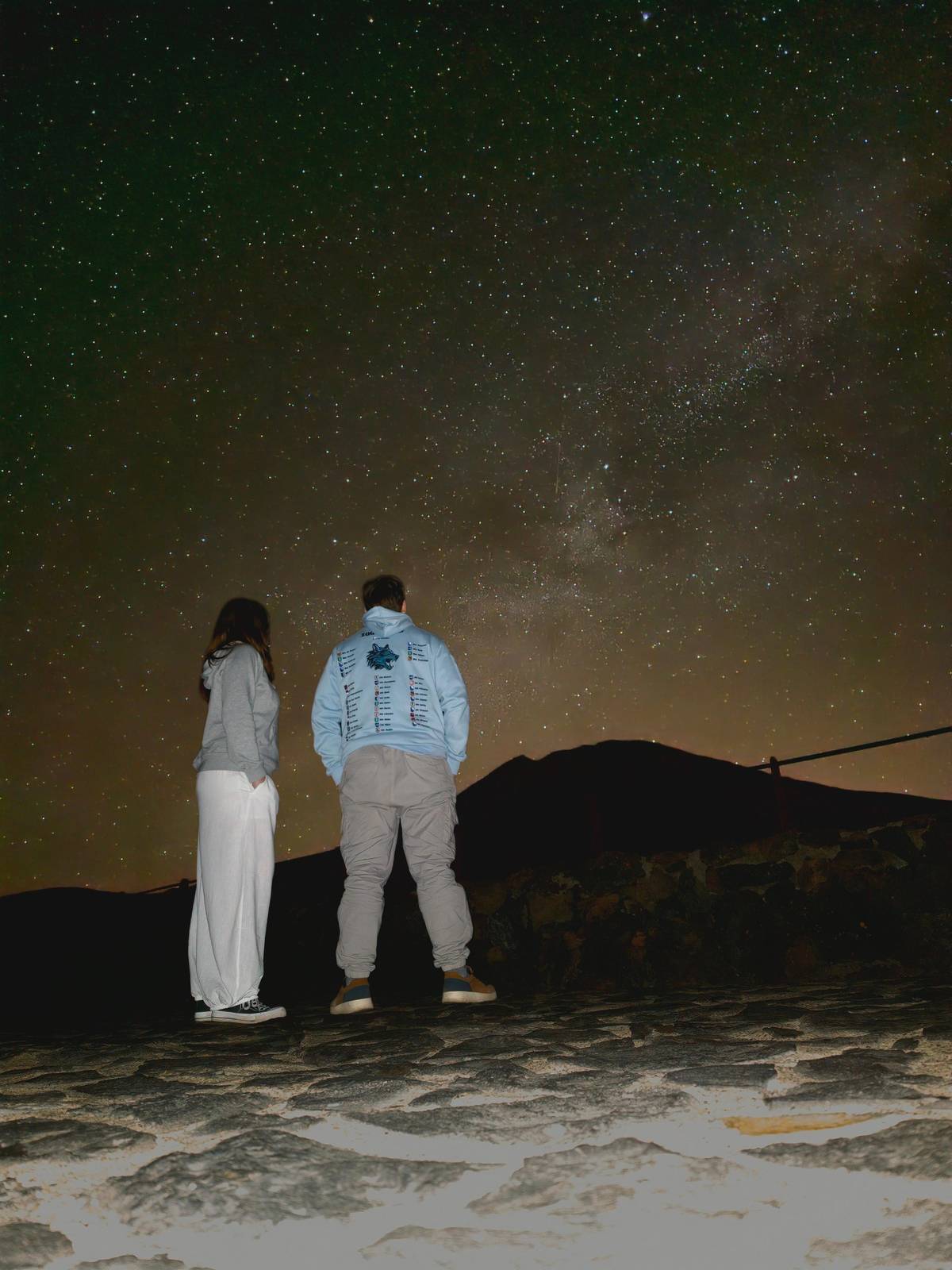
What makes the effort worthwhile is how seriously the sky is protected. The park holds the Starlight certification both as a tourist destination and as a reserve, and it lists astronomical observation among its natural values.1011 Height and distance from the resorts do the rest, keeping the glow of the coast low on the horizon instead of across the whole sky.
A night on your own
How to plan an evening in the park
-
Afternoon
Check the sky and Moon
Pick a night away from full Moon, which lights the sky all night.12
-
Before 16:00
Visitor center
Cañada Blanca and El Portillo are the last staffed stops of the day.8
-
Sunset
Park at a viewpoint
-
After dark
Let your eyes adapt
Allow 15 to 30 minutes with no bright light.13
-
Night
Observe
-
Late
Drive down slowly
Back on the TF-21 or TF-24, headlights low near other observers.3
Teide stargazing spots worth driving to
Turismo de Tenerife names a short list of Teide stargazing spots, and most sit close to the road.1 La Ruleta viewpoint, right next to the Roques de García, has plenty of space to set up a telescope, and the rock towers make a dramatic outline against the stars for photographs.1
The area around the Parador de Las Cañadas is the easiest base. It is the only hotel inside the park, with a coffee shop open to the public and a large car park close to La Ruleta and the Roques de García.2 Several guided sessions meet here too, including the one booked on this page.
Further along the TF-21, the Llano de Ucanca viewpoint looks over a wide plain at the foot of the road, and the Tabonal Negro viewpoint has a small car park.15 For the fit, Guajara is the third highest point in the park at 2,715 m, where the astronomer Jean Mascart watched Halley's comet in 1910.1617
Viewpoints compared
Where to set up in the park
| Spot | Getting there | Good for | Note |
|---|---|---|---|
| La Ruleta | Beside the Roques de García | A telescope | Plenty of space |
| Parador area | Hotel car park | First nights | Public coffee shop |
| Llano de Ucanca | Foot of the TF-21 | Wide horizons | Open plain |
| Tabonal Negro | Next to the TF-21 | Quick stops | Small car park |
| Guajara | Degollada path | Fit walkers | Height 2,715 m |
From Turismo de Tenerife's guide to stargazing places in the park; park only in designated areas.1215164
Guided sessions in the park
Three sessions you drive to
Booked here Longest of three
 Photos sent
Decision helper
On your own or with a guide?
It depends on your car, your gear and your curiosity
Go on your own
Binoculars on a tripod are enough for a first night.14
A guided session
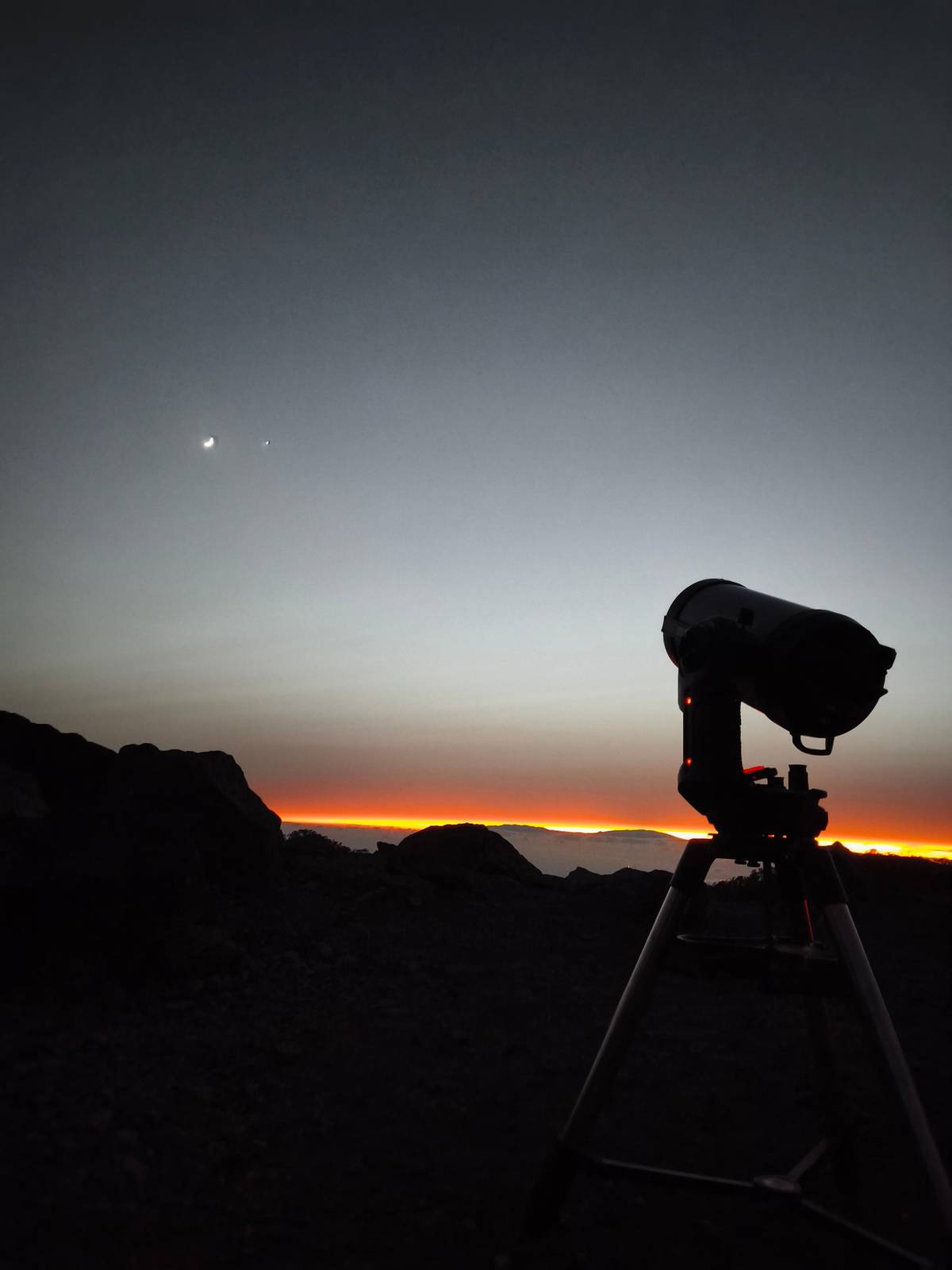
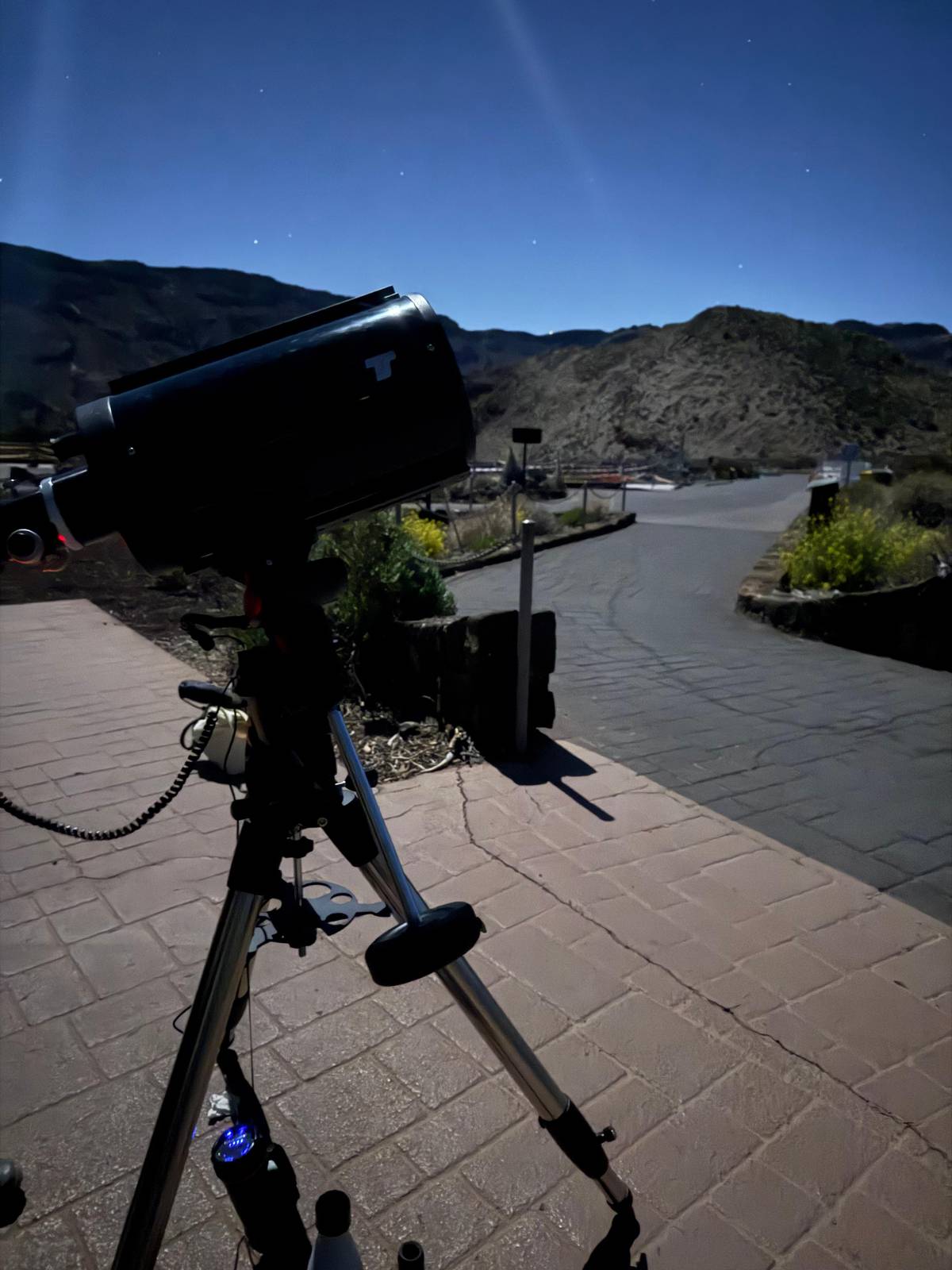
The booked session brings an 8-inch telescope.
Short and close
The booked session may not suit children under 7 to 9.
Minas de San José
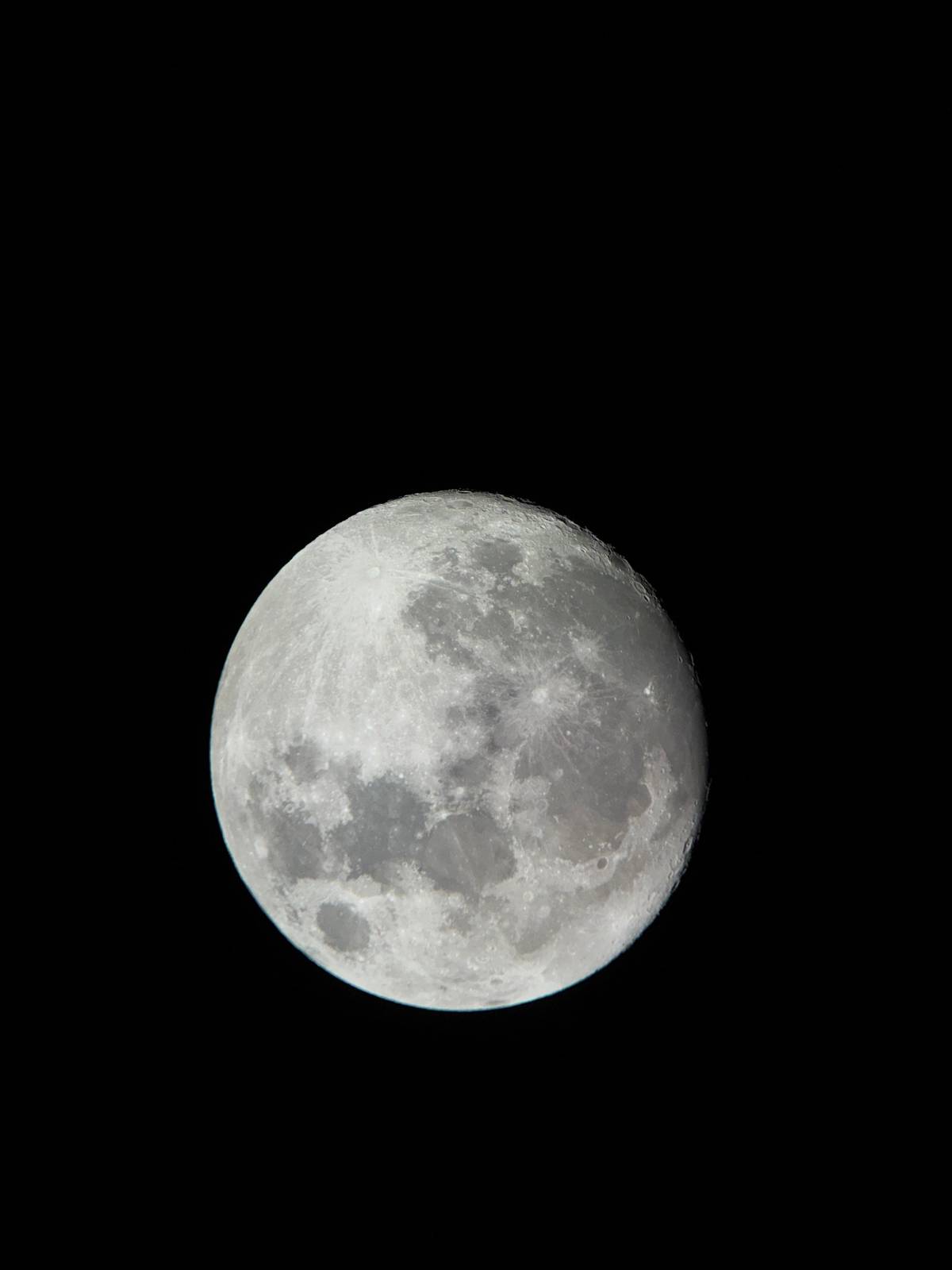
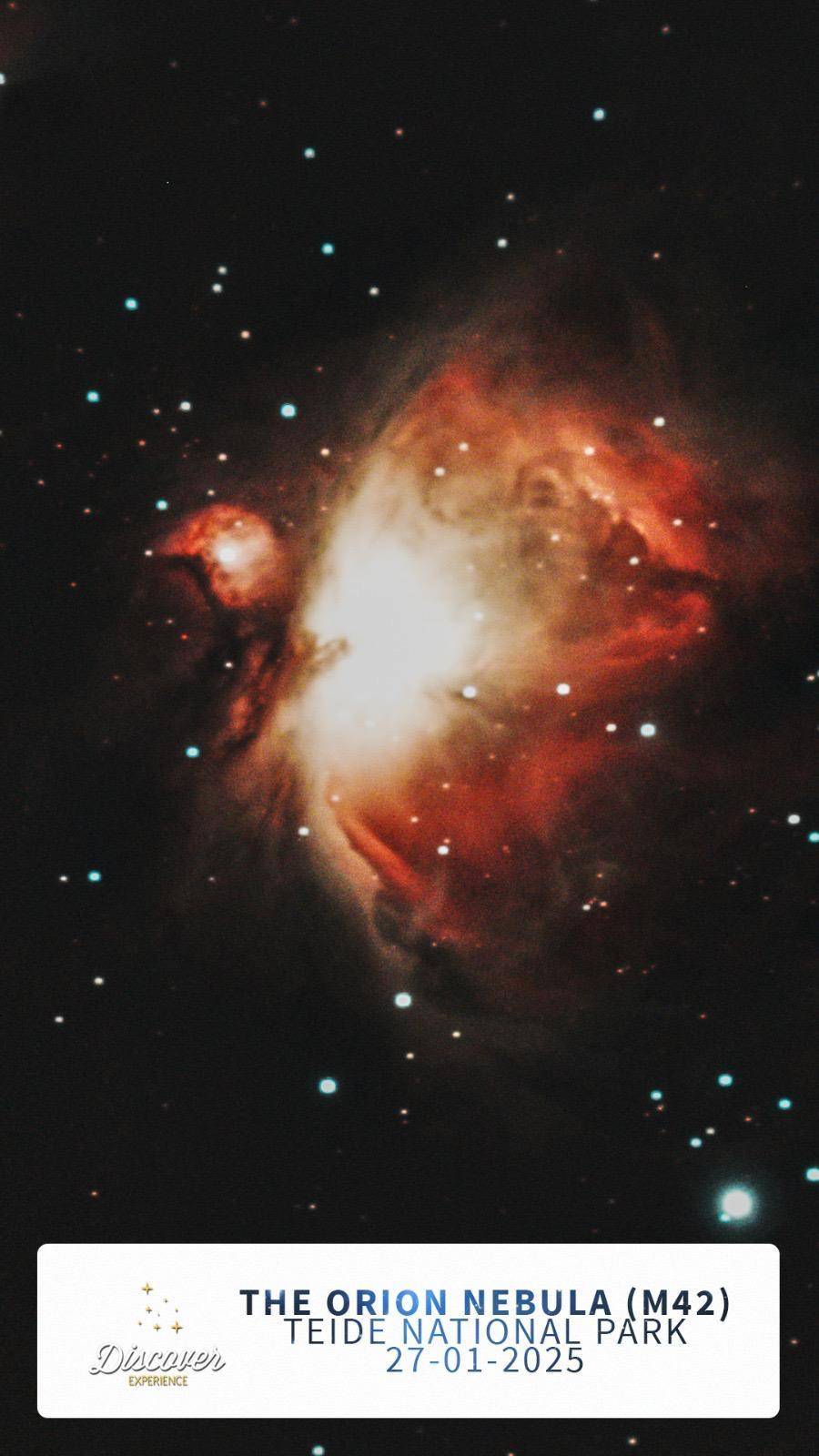
Astrophotos taken on the night are sent afterwards.
A pickup evening
The site's sunset evening collects guests on the south coast.
It is also considered as a Starlight Reserve, a space with a specific commitment to defending the quality of the night sky.
Stargazing in Tenerife on your own: getting up there
Stargazing in Tenerife on your own means driving. The park lists its roads in: the TF-21 from La Orotava in the north, the TF-24 from La Laguna through La Esperanza in the east, the TF-21 from Granadilla de Abona through Vilaflor in the south, and the TF-38 from Chío in the west.3
From the north, the TF-21 runs 31 km from La Orotava to El Portillo; from the east the TF-24 runs 30 km to the same junction.3 From the south coast the climb through Vilaflor ends at Boca de Tauce, close to the Parador and the Roques de García. Allow for a slow drive down in the dark, on bends, after a long evening outside.
Buses do reach the park. TITSA line 348 runs from Puerto de la Cruz through La Orotava to the Parador, and line 342 from Costa Adeje through Los Cristianos and Vilaflor.1920 Check their timetables before relying on one: a stargazing night ends long after most day trips, and being stranded high on the mountain is no fun.
Map
From the coast to the dark viewpoints of Las Cañadas
First the island with the towns tours leave from, then the high caldera with its viewpoints and the observatory, then the few hundred metres around the Parador where many sessions meet.
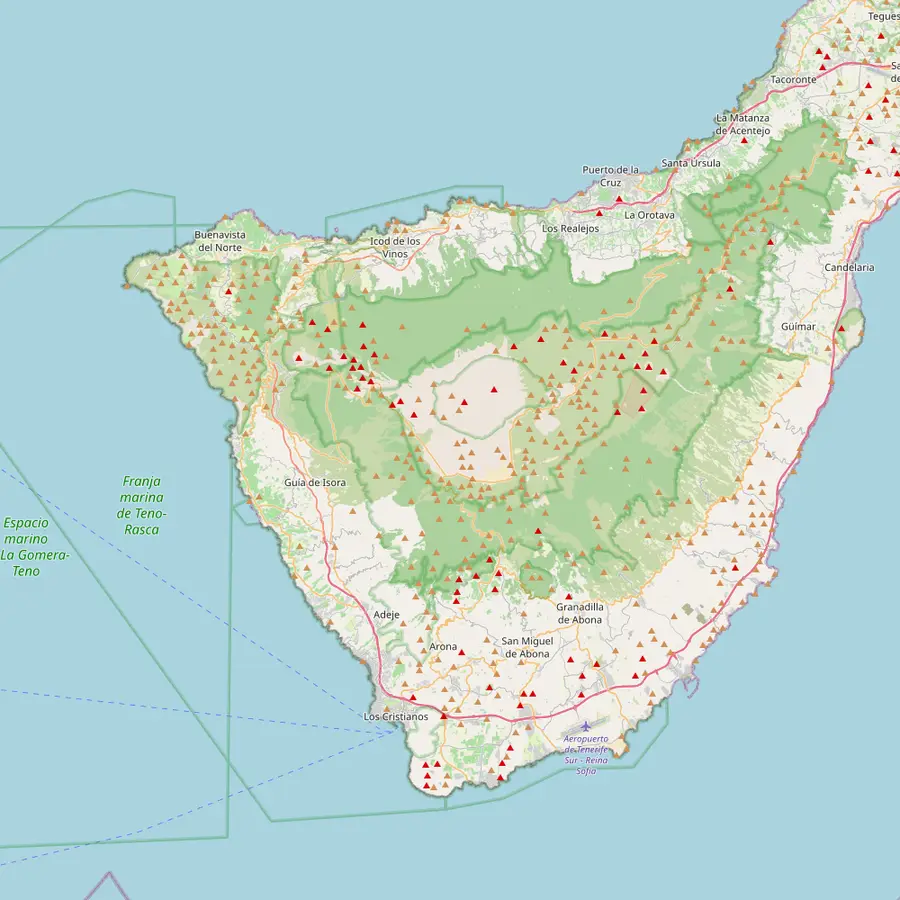 1Teide summit2Puerto de la Cruz3La Orotava4El Portillo5Teide Observatory6Los Cristianos7Costa Adeje8El Médano9Los Gigantes10Vilaflor11Mirador de Samara12Parador de Las Cañadas
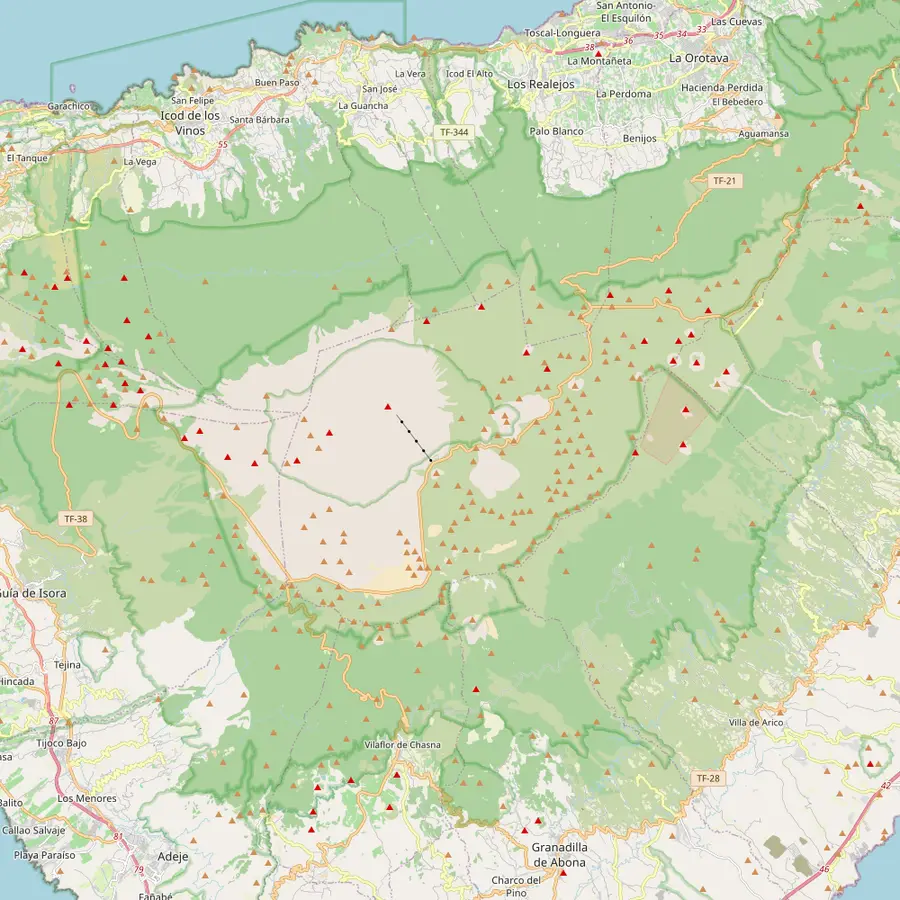 1Teide summit4El Portillo5Teide Observatory11Mirador de Samara12Parador de Las Cañadas13Cable car base station14Llano de Ucanca15Minas de San José16Guajara17Boca de Tauce
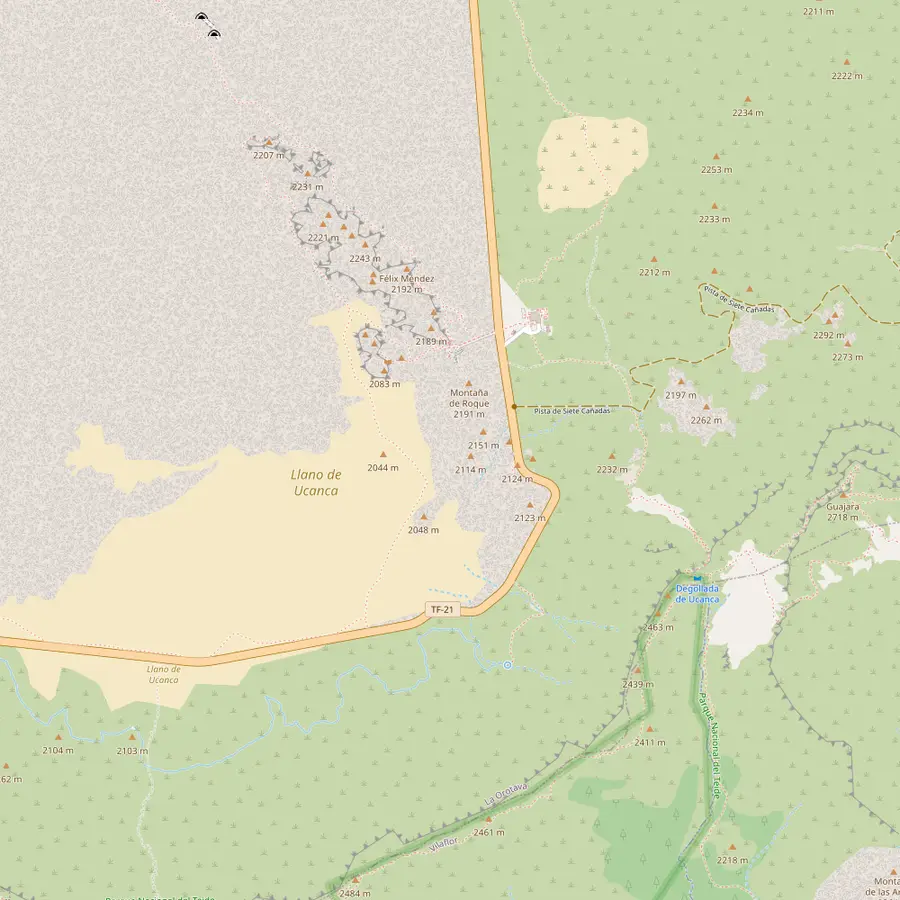 12Parador de Las Cañadas14Llano de Ucanca19Roques de García20La Ruleta
- 1Teide summit
The highest peak in Spain, 3,715 m; the site tour stays at public viewpoints below it.21
In Google Maps ↗ - 2Puerto de la Cruz
The north-coast town where bus 348 starts its climb to the Parador.19
In Google Maps ↗ - 3La Orotava
The TF-21 runs 31 km from here up to El Portillo.3
In Google Maps ↗ - 4El Portillo
Visitor centre at the north gate of the caldera, open 9:00 to 16:15.8
In Google Maps ↗ - 5Teide Observatory
The IAC observatory at Izaña, 2,390 m, mainly a solar observatory.2223
In Google Maps ↗ - 6Los Cristianos
The VIP option of the site tour drops guests back here and along the south coast.
In Google Maps ↗ - 7Costa Adeje
Inside the pickup zone of the site tour, which runs from El Médano to Los Gigantes.
In Google Maps ↗ - 8El Médano
The eastern end of the site tour's pickup coast.
In Google Maps ↗ - 9Los Gigantes
The western end of the site tour's pickup coast.
In Google Maps ↗ - 10Vilaflor
The TF-21 from the south climbs through Vilaflor to Boca de Tauce.3
In Google Maps ↗ - 11Mirador de Samara
Sunset viewpoint used by small-group picnic tours, 80 minutes on one listing.
In Google Maps ↗ - 12Parador de Las Cañadas
The only hotel in the park, with a public coffee shop; the Ermita de las Nieves stands beside it.2
In Google Maps ↗ - 13Cable car base station
The cable car climbs from 2,356 m to 3,555 m in roughly 8 minutes.24
In Google Maps ↗ - 14Llano de Ucanca
A viewpoint at the foot of the TF-21 on the caldera floor.15
In Google Maps ↗ - 15Minas de San José
Meeting point for an 80-minute telescope session; come by car.
In Google Maps ↗ - 16Guajara
The third highest point in the park, 2,715 m, where Mascart watched Halley's comet in 1910.1617
In Google Maps ↗ - 17Boca de Tauce
Where the TF-21 from the south and the TF-38 from Chío meet.3
In Google Maps ↗ - 19Roques de García
Rock towers beside the Parador; a picnic tour stops here.2
In Google Maps ↗ - 20La Ruleta
Viewpoint next to the Roques de García with room for a telescope.1
In Google Maps ↗
Checklist
For a night in the park on your own
01
Bring
- Warm coat, hat and gloves
- A thermos with a hot drink
- A torch with a red filter
- Binoculars or a small telescope
02
Respect
- Park only in marked areas
- No drones, no fires, no camping
- Chairs only in authorized zones
Cost calculator
A guided session for your group
Starting totals for sessions that meet in the park.
People
Total from$93
from, per person $47
Check availabilityfree cancellationStarting prices from each GetYourGuide listing, turned into your currency with the European Central Bank rate; the booking page shows what you will actually pay.
Video
Mount Teide on Tenerife: what you need to know
No video data loads before you press play.
The park rules still apply after dark
Night does not suspend the park's rules. You may stop and park only in the designated areas, and you move only on authorized roads and paths.4 That rules out pulling onto the lava for a better view, however empty the road looks at midnight.
Tents, sunshades, hammocks, tables, chairs and other outdoor furniture may not be set up outside authorized areas.5 Free camping is not allowed at all, and bivouacking is permitted only in set areas above 2,500 m.25 Lighting a fire in the open is not allowed, so a thermos is your only source of warmth.26
Keep the sky quiet as well as dark. Drones are among the activities to avoid, as are kites, balloons and fireworks, and loud radios and megaphones are out too.2728 Professional photography and filming need prior authorization.29 Turismo de Tenerife advises checking in advance whether a protected area needs a permit.30
The telescope session booked on this page
If you want a guide without a long coach evening, the session booked here meets at the entrance patio of the Parador de Las Cañadas del Teide, so you drive yourself or take a taxi. It lasts 1.5 hours, is led by an astrophysicist who is also a certified official guide, and keeps groups to 10.
The instrument is an 8-inch telescope, and each group hears one language only, English or Spanish. Group sessions run on Tuesdays and Fridays; on other days private sessions can be arranged. It starts from $47 and averages 4.95 from 86 reviews; cancelling is free until 24 hours ahead.
The operator is frank about the cold. It advises warm clothing for 0 to 4 °C from October to March and 10 to 15 °C from April to September, and says the night may not suit children under 7 to 9. If the operator cancels for weather you get a full refund.
Light, eyes and a red torch
The darkness is only useful if you let your eyes use it. The human eye needs 15 to 30 minutes to adapt to darkness, and a strong beam such as a torch or car headlights ruins that; after it you wait another 15 minutes.13 Park facing away from the road if you can, and switch your headlights off as soon as you stop.
Turismo de Tenerife's advice is simple: stay away from cities, roads and the Moon, especially when it is full, and put a red strip over your torch so it only shines as brightly as you need to read a star map.31 A phone in night mode with the brightness turned right down does the same job.
Equipment can be as simple as you like. The tourism board says it ranges from binoculars on a tripod to sophisticated telescopes.14 A star app helps you put names to what you see, and a reclining chair would be lovely, but remember that chairs are not allowed outside authorized areas, so a mat on a viewpoint wall or a car seat is the realistic option.5 Whatever you bring, test it at home in the dark first: fiddly tripods and unfamiliar apps are much harder to handle with cold fingers.
Cold, altitude and staying safe
The park's climate is dry, with strong contrasts between day and night and often strong winds.32 On cold winter nights the temperature at the island's highest points can easily drop below freezing, so a coat and a hot drink are essentials, not extras.630
Snow near the Parador is unlikely, falling only a couple of days a year in winter, and the forecasts usually warn of it.33 Even so, a clear evening can turn into fog or wind within an hour, and there is no shop or warm room open late to retreat to. Keep the car fueled, carry water, and tell someone where you are going.
Altitude affects some visitors more than they expect. If you feel dizzy, short of breath or unwell, the cure is to drive down, not to push on. Children tire quickly in the cold, and a short session close to the car often beats an ambitious plan to reach a remote viewpoint. Agree on a time to leave before you arrive, keep the car keys in a pocket you can find by feel, and pack the gear in the order you will need it, warm clothes on top. Those small habits make the difference between a relaxed night and a fumbling one in the cold.
Your night on Teide
Sunset with Cava, then the stars.
Hotel pickup in the south or your own car; choose an evening, and change your mind free until 24 hours ahead.


You ask,we answer.
Can I watch the stars in the park without a tour?
Yes, by car. Drive in on the TF-21, TF-24 or TF-38 and use the marked viewpoints and car parks.34
Where is the best place to stargaze in the park?
La Ruleta and the Parador area. Turismo de Tenerife names both; La Ruleta has room for a telescope.12
Can I camp overnight to watch the stars?
No free camping. Free camping is not allowed; bivouacking is allowed only in set areas above 2,500 m.25
Can I bring a folding chair to a viewpoint?
Not outside authorized areas. Chairs, tables and other outdoor furniture may not be set up outside authorized zones.5
Is a drone allowed for night photos?
No. The park lists drones among the activities to avoid, with kites and balloons.27
Is the visitor center open at night?
No. El Portillo closes at 16:15 and Cañada Blanca at 16:00, so nobody is on duty there after dark.8
Where does the astrophysicist session meet?
At the Parador. At the entrance patio of the Parador de Las Cañadas del Teide; come by car or taxi.
Sources
Sources and evidence
- 1Turismo de Tenerife (webtenerife.co.uk, official tourism site)The best places for stargazing in Tenerife↩
- 2Turismo de Tenerife (webtenerife.co.uk, official tourism site)The best places for stargazing in Tenerife↩
- 3Parque Nacional del Teide (Gobierno de Canarias)Accesos↩
- 4Parque Nacional del Teide (Gobierno de Canarias)Normas de visita↩
- 5Parque Nacional del Teide (Gobierno de Canarias)Normas de visita↩
- 6Turismo de Tenerife (webtenerife.co.uk, official tourism site)Stargazing in Tenerife: Unique views of the sky↩
- 7Ministerio para la Transición Ecológica (Red de Parques Nacionales)Parque Nacional del Teide↩
- 8Parque Nacional del Teide (Gobierno de Canarias)Centros y horarios↩
- 9Parque Nacional del Teide (Gobierno de Canarias)Ficha técnica↩
- 10Parque Nacional del Teide (Gobierno de Canarias)Ficha técnica↩
- 11Parque Nacional del Teide (Gobierno de Canarias)Ficha técnica↩
- 12NASA ScienceMoon Phases↩
- 13Turismo de Tenerife (webtenerife.co.uk, official tourism site)Stargazing in Tenerife: Unique views of the sky↩
- 14Turismo de Tenerife (webtenerife.co.uk, official tourism site)Stargazing in Tenerife: Unique views of the sky↩
- 15Turismo de Tenerife (webtenerife.co.uk, official tourism site)The best places for stargazing in Tenerife↩
- 16Turismo de Tenerife (webtenerife.co.uk, official tourism site)The best places for stargazing in Tenerife↩
- 17Turismo de Tenerife (webtenerife.co.uk, official tourism site)The best places for stargazing in Tenerife↩
- 18Turismo de Tenerife (webtenerife.co.uk, official tourism site)Stargazing in Tenerife: magical and unforgettable nights↩
- 19Parque Nacional del Teide (Gobierno de Canarias)Accesos↩
- 20Parque Nacional del Teide (Gobierno de Canarias)Accesos↩
- 21Ministerio para la Transición Ecológica (Red de Parques Nacionales)Parque Nacional del Teide↩
- 22Instituto de Astrofísica de Canarias (IAC)Teide Observatory↩
- 23Instituto de Astrofísica de Canarias (IAC)Teide Observatory↩
- 24Turismo de Tenerife (webtenerife.co.uk, official tourism site)Teide National Park↩
- 25Parque Nacional del Teide (Gobierno de Canarias)Normas de visita↩
- 26Parque Nacional del Teide (Gobierno de Canarias)Normas de visita↩
- 27Parque Nacional del Teide (Gobierno de Canarias)Normas de visita↩
- 28Parque Nacional del Teide (Gobierno de Canarias)Normas de visita↩
- 29Parque Nacional del Teide (Gobierno de Canarias)Normas de visita↩
- 30Turismo de Tenerife (webtenerife.co.uk, official tourism site)The best places for stargazing in Tenerife↩
- 31Turismo de Tenerife (webtenerife.co.uk, official tourism site)Stargazing in Tenerife: Unique views of the sky↩
- 32Ministerio para la Transición Ecológica (Red de Parques Nacionales)Parque Nacional del Teide↩
- 33Turismo de Tenerife (webtenerife.co.uk, official tourism site)Stargazing in Tenerife: Unique views of the sky↩