 Booked here
Guides
Language
EnglishCurrency
US dollar · $Your currency applies on GetYourGuide too.
Guide · Sunset
Mount Teide sunset and stargazing above the sea of clouds
A Mount Teide sunset and stargazing evening often begins above a white sea of cloud. Here is why it forms, where tours watch the sun go down, and how dusk turns into a night sky.
Check availabilityfrom $47 · no cancellation fee
Editorial team, tenerifestargazingtour.comUpdated October 23, 20266-minute read22 sources
In a nutshell
- 01Sea of clouds
- Stratocumulus pushed by the trade winds, at 500 to 1,500 m.1
- 02Booked here
- Sunset at a 1,400 m viewpoint with a glass of Cava.
- 03Facing
- La Palma, La Gomera and El Hierro on the horizon.
- 04After sunset
- A second viewpoint and 2.25 hours of stargazing.
- 05Price
- From $47, free cancellation up to 24 hours before.
Why the sun sets over a white sea
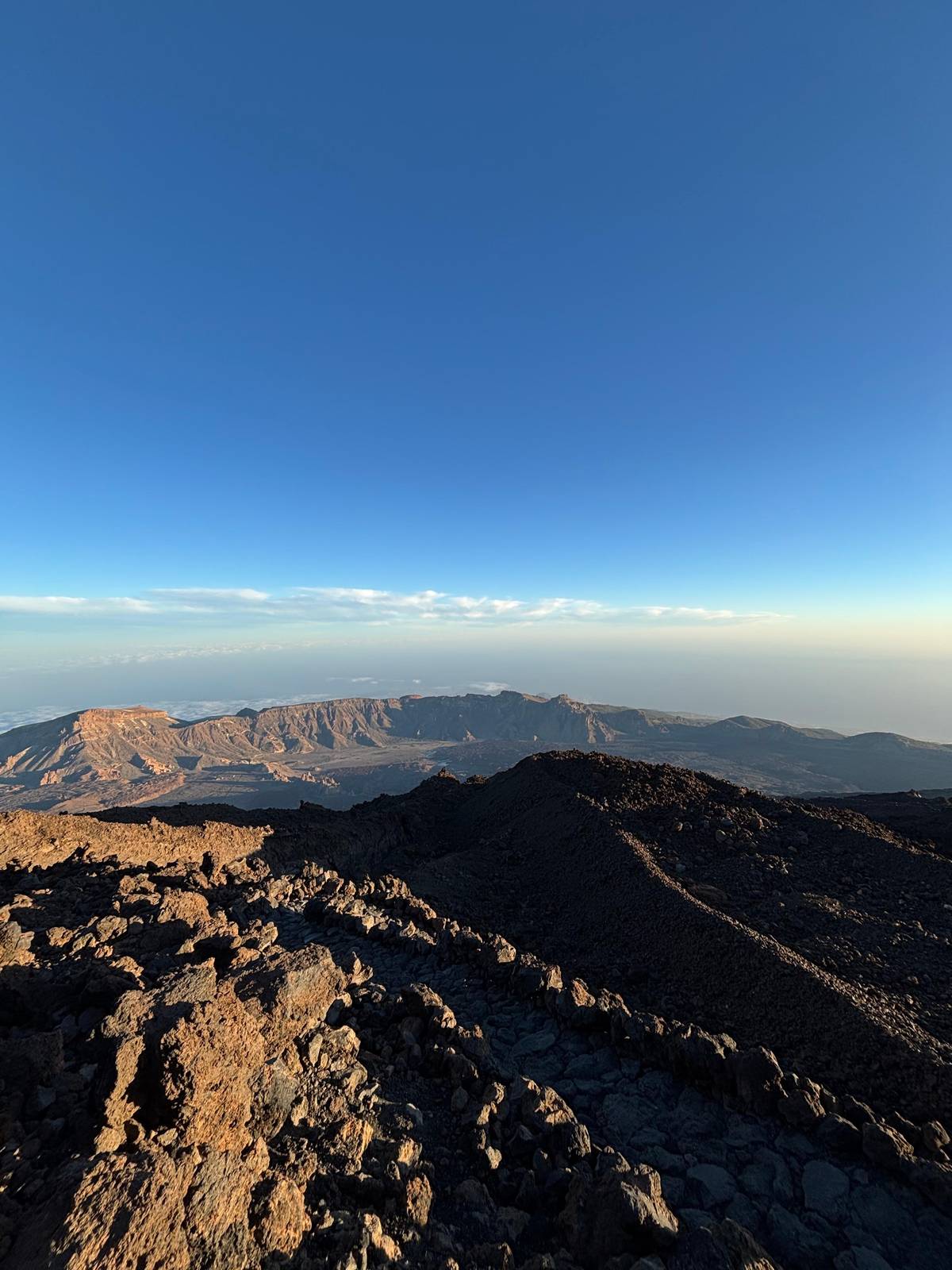
On many evenings the most memorable thing about a sunset on Teide is what lies below it. Turismo de Tenerife explains that the trade winds push clouds up against the mountains in the north of the island, building a horizontal layer of stratocumulus between 500 and 1,500 m.1 Climb above that layer and the ocean disappears under a soft white floor.
The drive up shows you the whole process. You see the cloud from below on the coast, pass through it on the way up, and then look down on it with the sun shining on its top.2 On days without the cloud you get the opposite reward: a clear view down over the island and out to sea.1
Higher still is the park itself, which runs from pine forest at 1,600 m up to the 3,715 m summit.3 Most viewpoints the tours use sit above the usual cloud band, though the booked evening's sunset stop, at 1,400 m, is close to its upper edge, so on some evenings the cloud reaches it. On the others, the question is how thick the white sea below you will be. Some nights it is a thin veil with towns glowing through it; on others it is a solid, rolling surface that hides every light on the coast, which is exactly what you want for the stars that follow.
The evening, as listed
From pickup to the stars
-
Afternoon
Time by WhatsApp
Sent on the day; it replaces the time on your ticket.
-
Pickup
Van ride up
45 minutes into the mountains.
-
Sunset
Viewpoint at 1,400 m
45 minutes with photos and a glass of Cava.
-
Dusk
Short hop
5 minutes by van to a darker viewpoint.
-
Night
Guided stargazing
2.25 hours with a laser pointer and a telescope.
-
Late
Back down
The van returns towards Los Cristianos.
The sunset stop on the evening booked here
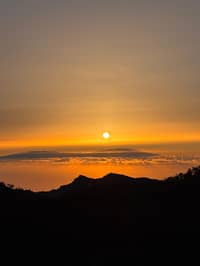
The evening booked on this page reaches its sunset viewpoint after a van ride of 45 minutes. The viewpoint is given at 1,400 m, beside a lava flow, and faces La Palma, La Gomera and El Hierro, so on a clear evening the sun drops behind one of the western islands.
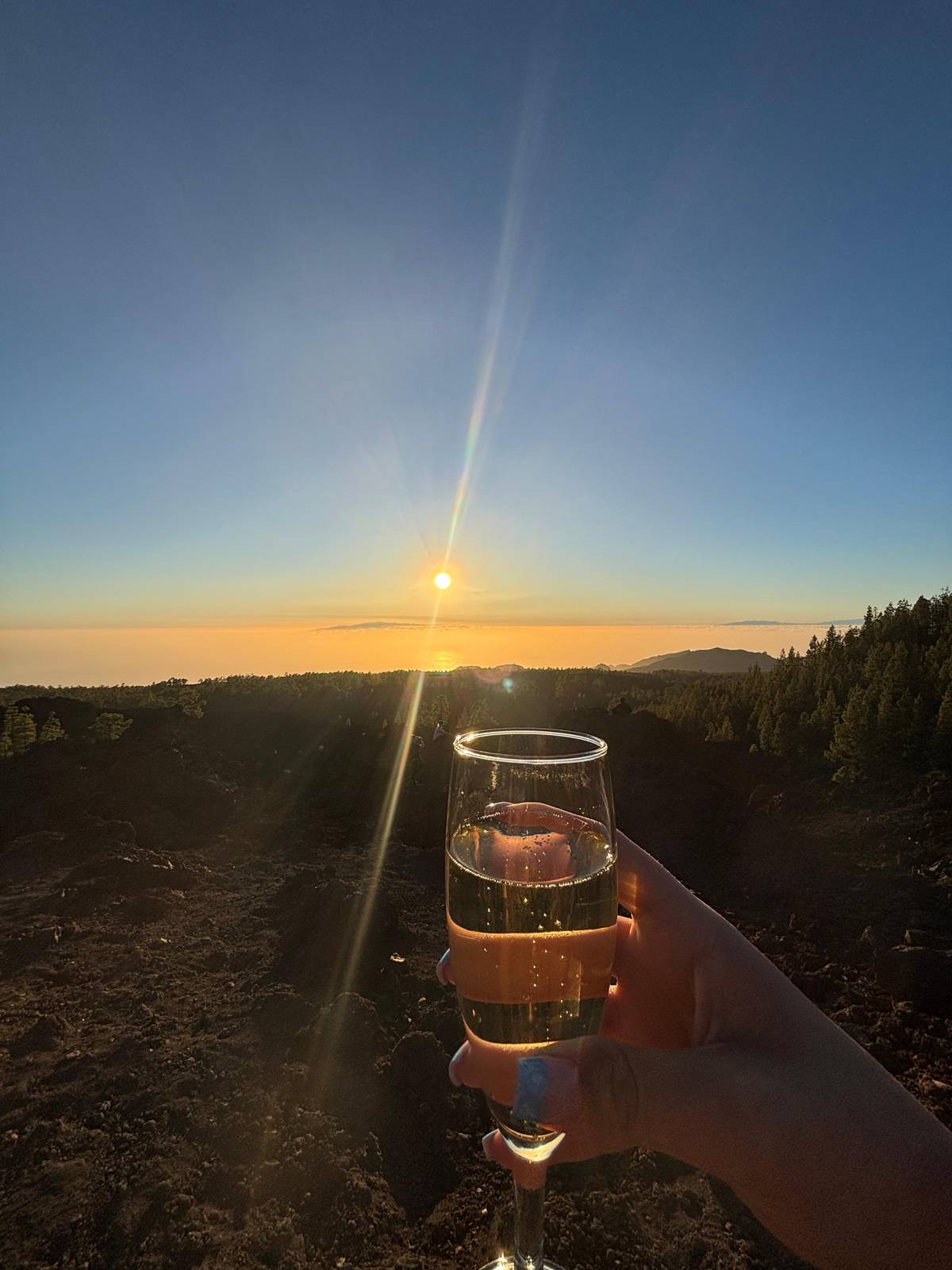
You have 45 minutes there for photos, the sunset itself and a welcome drink: a glass of Cava, the Spanish sparkling wine, or a non-alcoholic alternative. Recent guests describe the spot as busy, with other groups watching too, but say the shared atmosphere is relaxed and the views worth it.
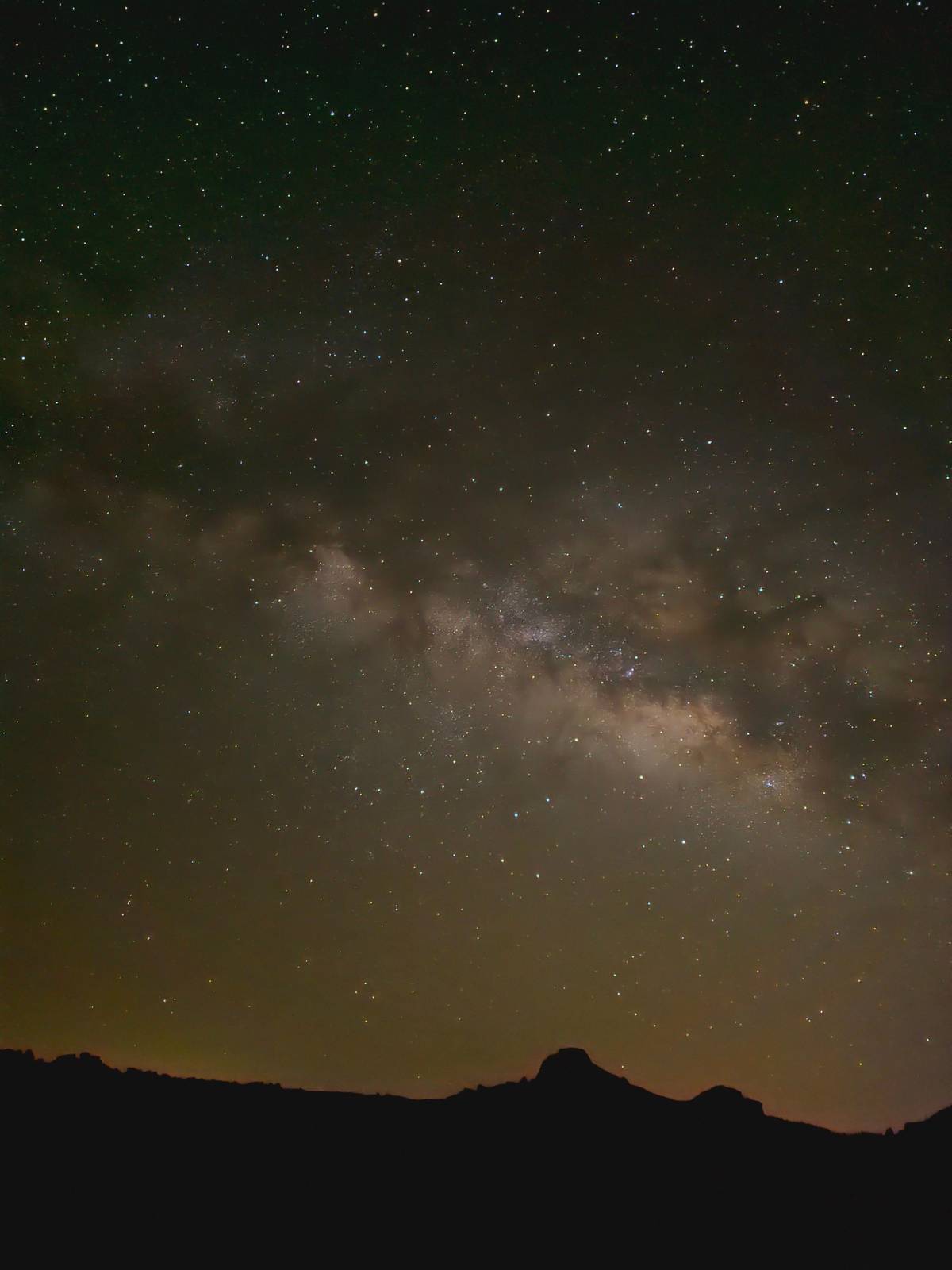
As the color drains away, the group climbs back into the van for a 5-minute ride to a second viewpoint, where the guided stargazing lasts 2.25 hours. That short hop matters: the sunset spot is chosen for the western horizon, the second one for a darker sky. You get both without having to drive a mountain road yourself if you pick the VIP option with pickup on the south coast.
Height above the sea
Where tours watch the sun go down
m
Sunset spots compared
Where each evening watches the sunset
| Evening | Sunset spot | Time there | Drink |
|---|---|---|---|
| Booked here | Viewpoint at 1,400 m | 45 min | Cava or soft drink |
| Picnic tour | Mirador de Samara | 80 min | Picnic |
| Minivan tour | Mirador de Samara | 30 min | Snack pack |
| 7 Cañadas dinner | At the restaurant | 1 hr | Cava or orange juice |
| Cable car evening | Upper station | Not listed | Dinner after |
From each GetYourGuide listing's own itinerary.
Three sunsets
Cava, a picnic, or the cable car
Booked here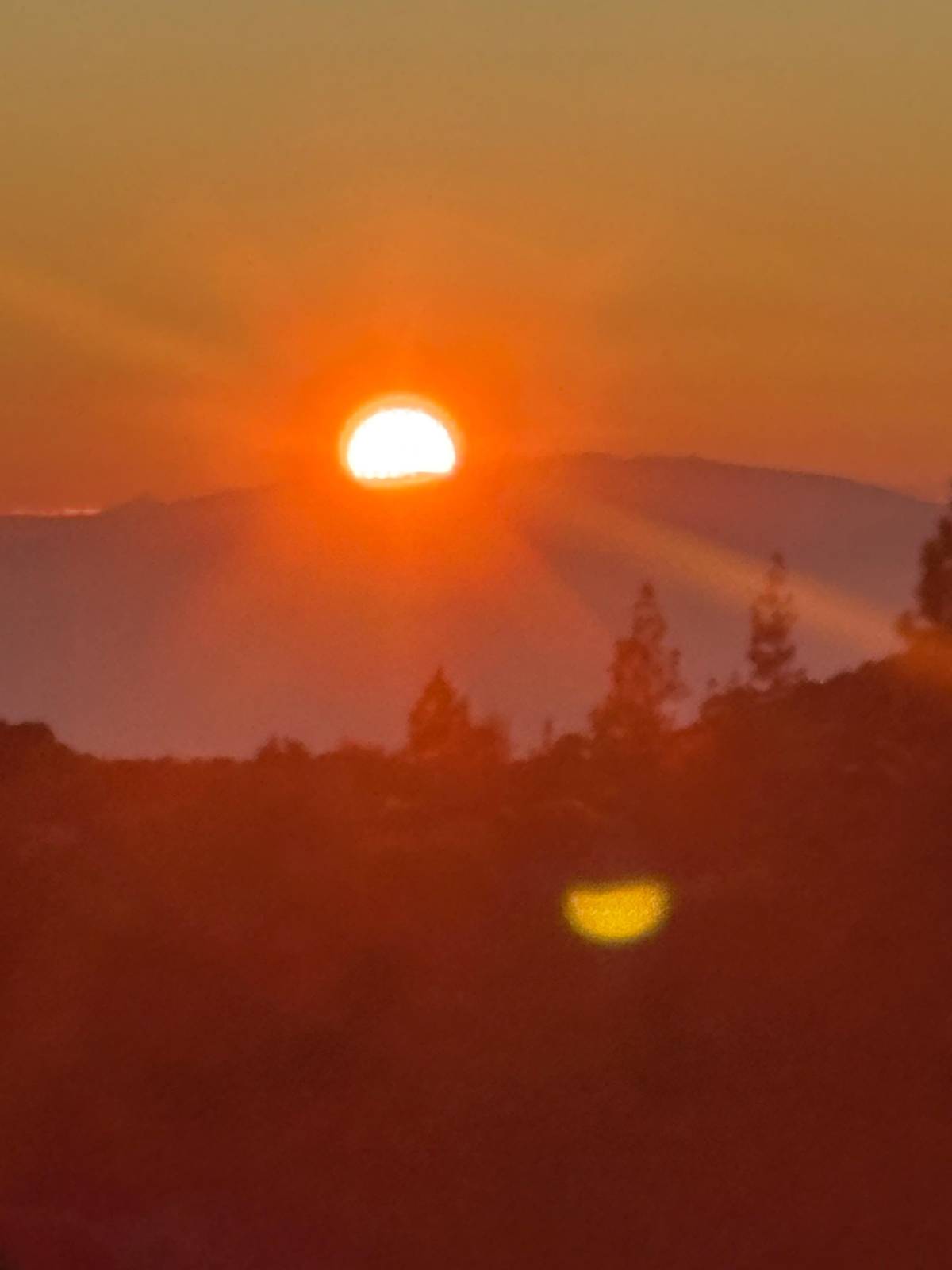 Small group
 Highest
Decision helper
Which sunset suits your evening?
Choose by budget, group size and altitude
The booked evening
Sunset with Cava, then 2.25 hours of stargazing.
Picnic at Samara
A picnic and the sunset, over 80 minutes at the viewpoint.
Cable car evening
Sunset from the upper station at 3,555 m.
Stay below
Pregnant women and people with heart problems may not take the cable car ride.
Puerto de la Cruz day
It starts in La Paz and watches the sunset at Mirador El Retamar.
Visitors see the blanket from below; next, they journey through it on their way up; and finally they see it from the above.
Other viewpoints the tours use at dusk
Each operator has its favorite place for the last light. Several small-group evenings head for Mirador de Samara: a picnic tour of up to 8 spends 80 minutes there with food and the sunset, while a minivan tour stops for 30 minutes before its stargazing.
A small-group day from Puerto de la Cruz watches the sun go down at Mirador El Retamar, given at 2,100 m, after a lunch and stops at La Orotava and the Roques de García. The dinner evening at Restaurante 7 Cañadas, given at 2,130 m, gives the sunset a full hour with a glass of Cava or orange juice.
Two evenings go much higher. One watches the sunset near the base of the cable car, given at 2,356 m, before the telescopes. Another rides the cable car itself, 8 minutes up to the upper station at 3,555 m, and watches from there before dinner. Higher is not always better: wind and cold grow with altitude, and the upper station is not open to everyone.
Map
From the coast to the dark viewpoints of Las Cañadas
First the island with the towns tours leave from, then the high caldera with its viewpoints and the observatory, then the few hundred metres around the Parador where many sessions meet.
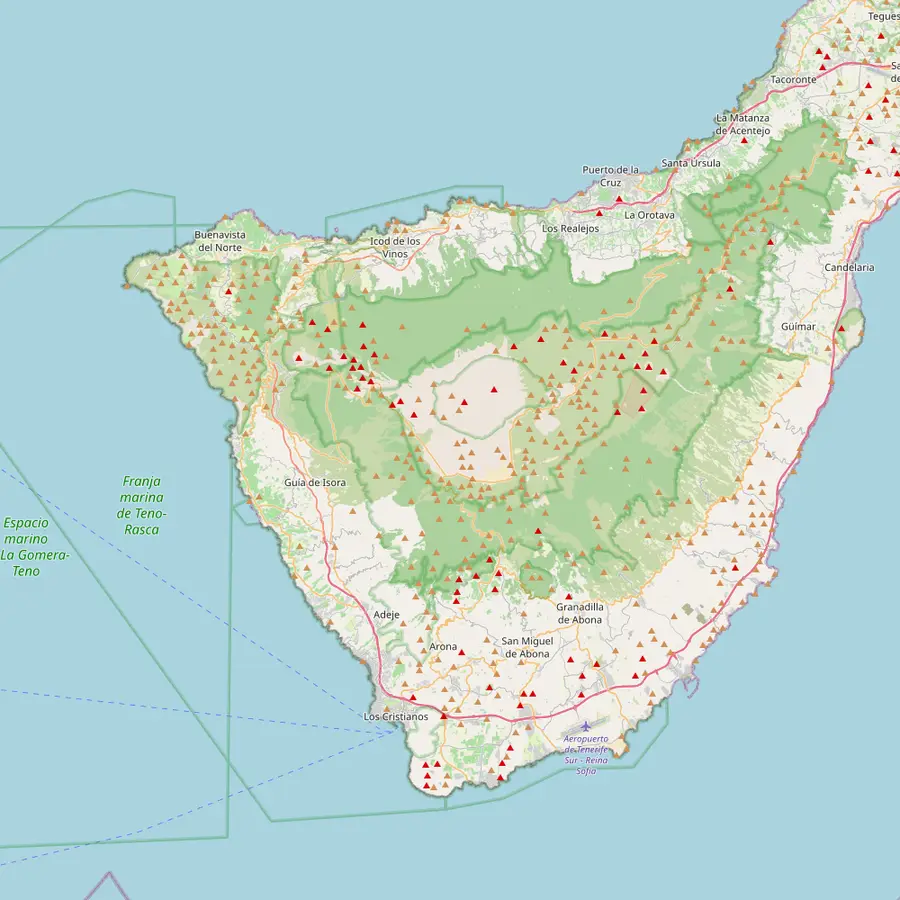 1Teide summit2Puerto de la Cruz3La Orotava4El Portillo5Teide Observatory6Los Cristianos7Costa Adeje8El Médano9Los Gigantes10Vilaflor11Mirador de Samara12Parador de Las Cañadas
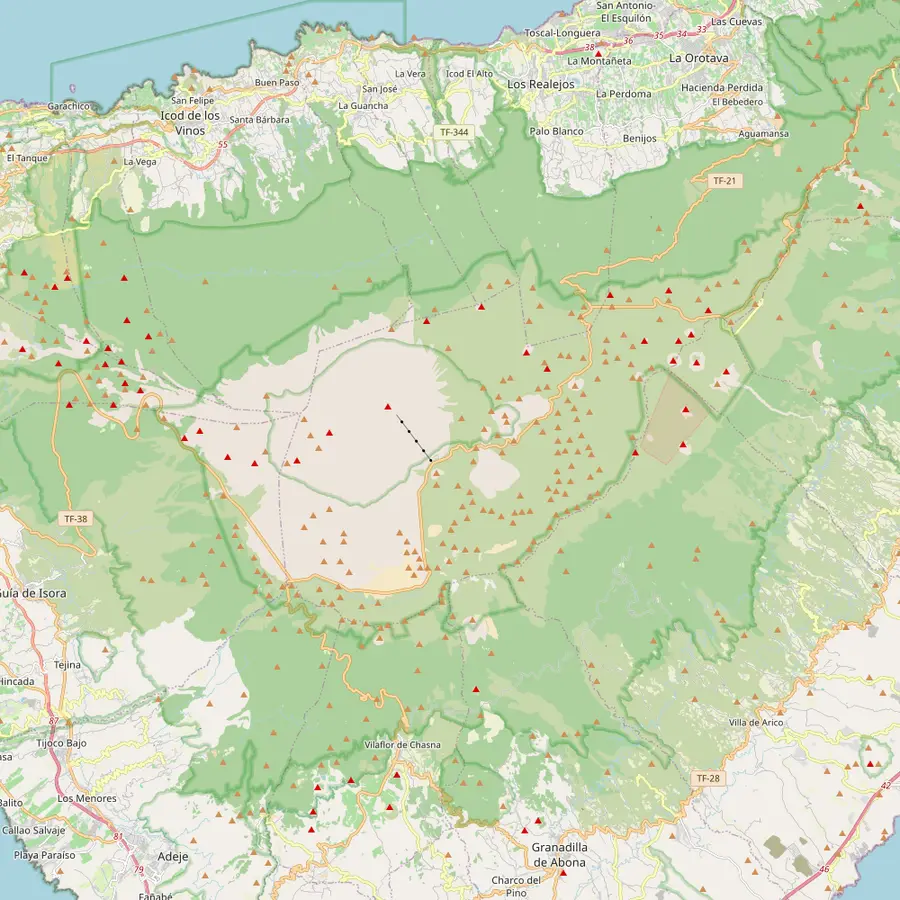 1Teide summit4El Portillo5Teide Observatory11Mirador de Samara12Parador de Las Cañadas13Cable car base station14Llano de Ucanca15Minas de San José16Guajara17Boca de Tauce
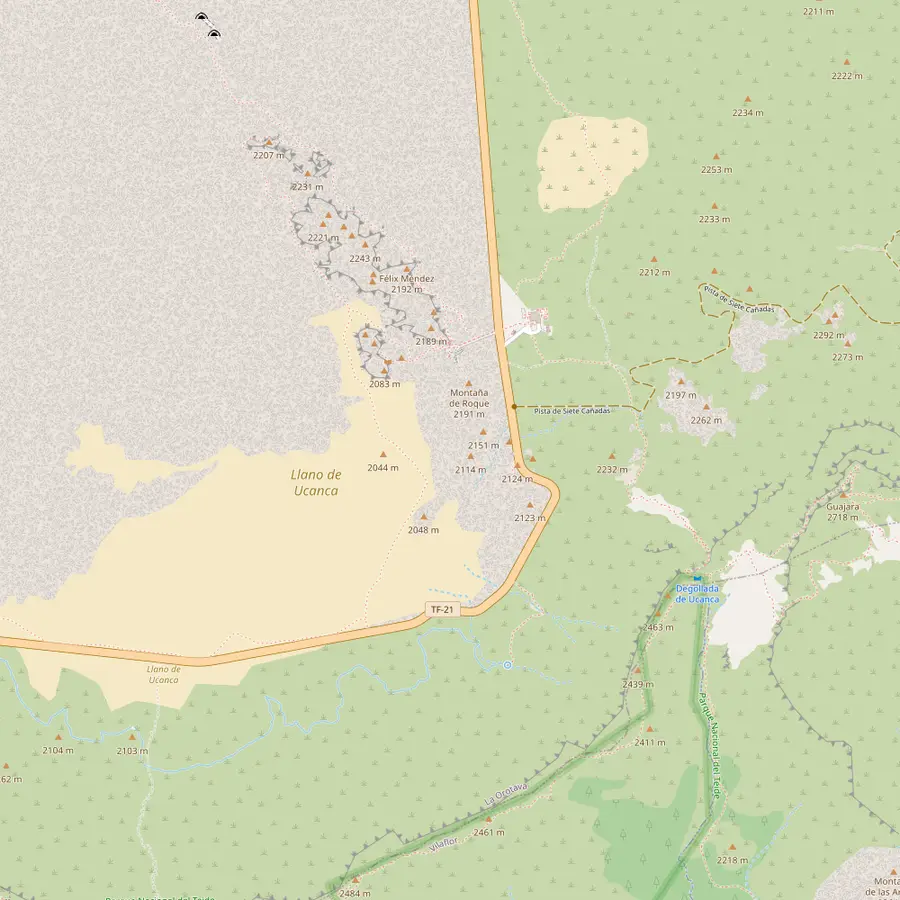 12Parador de Las Cañadas14Llano de Ucanca19Roques de García20La Ruleta
- 1Teide summit
The highest peak in Spain, 3,715 m; the site tour stays at public viewpoints below it.3
In Google Maps ↗ - 2Puerto de la Cruz
The north-coast town where bus 348 starts its climb to the Parador.4
In Google Maps ↗ - 3La Orotava
The TF-21 runs 31 km from here up to El Portillo.5
In Google Maps ↗ - 4El Portillo
Visitor centre at the north gate of the caldera, open 9:00 to 16:15.6
In Google Maps ↗ - 5Teide Observatory
The IAC observatory at Izaña, 2,390 m, mainly a solar observatory.78
In Google Maps ↗ - 6Los Cristianos
The VIP option of the site tour drops guests back here and along the south coast.
In Google Maps ↗ - 7Costa Adeje
Inside the pickup zone of the site tour, which runs from El Médano to Los Gigantes.
In Google Maps ↗ - 8El Médano
The eastern end of the site tour's pickup coast.
In Google Maps ↗ - 9Los Gigantes
The western end of the site tour's pickup coast.
In Google Maps ↗ - 10Vilaflor
The TF-21 from the south climbs through Vilaflor to Boca de Tauce.5
In Google Maps ↗ - 11Mirador de Samara
Sunset viewpoint used by small-group picnic tours, 80 minutes on one listing.
In Google Maps ↗ - 12Parador de Las Cañadas
The only hotel in the park, with a public coffee shop; the Ermita de las Nieves stands beside it.9
In Google Maps ↗ - 13Cable car base station
The cable car climbs from 2,356 m to 3,555 m in roughly 8 minutes.10
In Google Maps ↗ - 14Llano de Ucanca
A viewpoint at the foot of the TF-21 on the caldera floor.11
In Google Maps ↗ - 15Minas de San José
Meeting point for an 80-minute telescope session; come by car.
In Google Maps ↗ - 16Guajara
The third highest point in the park, 2,715 m, where Mascart watched Halley's comet in 1910.1213
In Google Maps ↗ - 17Boca de Tauce
Where the TF-21 from the south and the TF-38 from Chío meet.5
In Google Maps ↗ - 19Roques de García
Rock towers beside the Parador; a picnic tour stops here.9
In Google Maps ↗ - 20La Ruleta
Viewpoint next to the Roques de García with room for a telescope.14
In Google Maps ↗
Checklist
For a sunset above the clouds
01
Bring
- A warm layer for after dark
- Sunglasses for the low sun
- A charged phone for the WhatsApp time
02
Know
- The Moon's phase for your night
- Pickup follows the sunset, not your ticket
- No toilets at the viewpoints
Cost calculator
A sunset evening for your group
Starting totals for evenings that include the sunset.
People
Total from$93
from, per person $47
Check availabilityfree cancellationStarting prices from each GetYourGuide listing, turned into your currency with the European Central Bank rate; the booking page shows what you will actually pay.
Video
A sunset and stargazing tour on Teide, Tenerife
No video data loads before you press play.
From the last light to the first stars
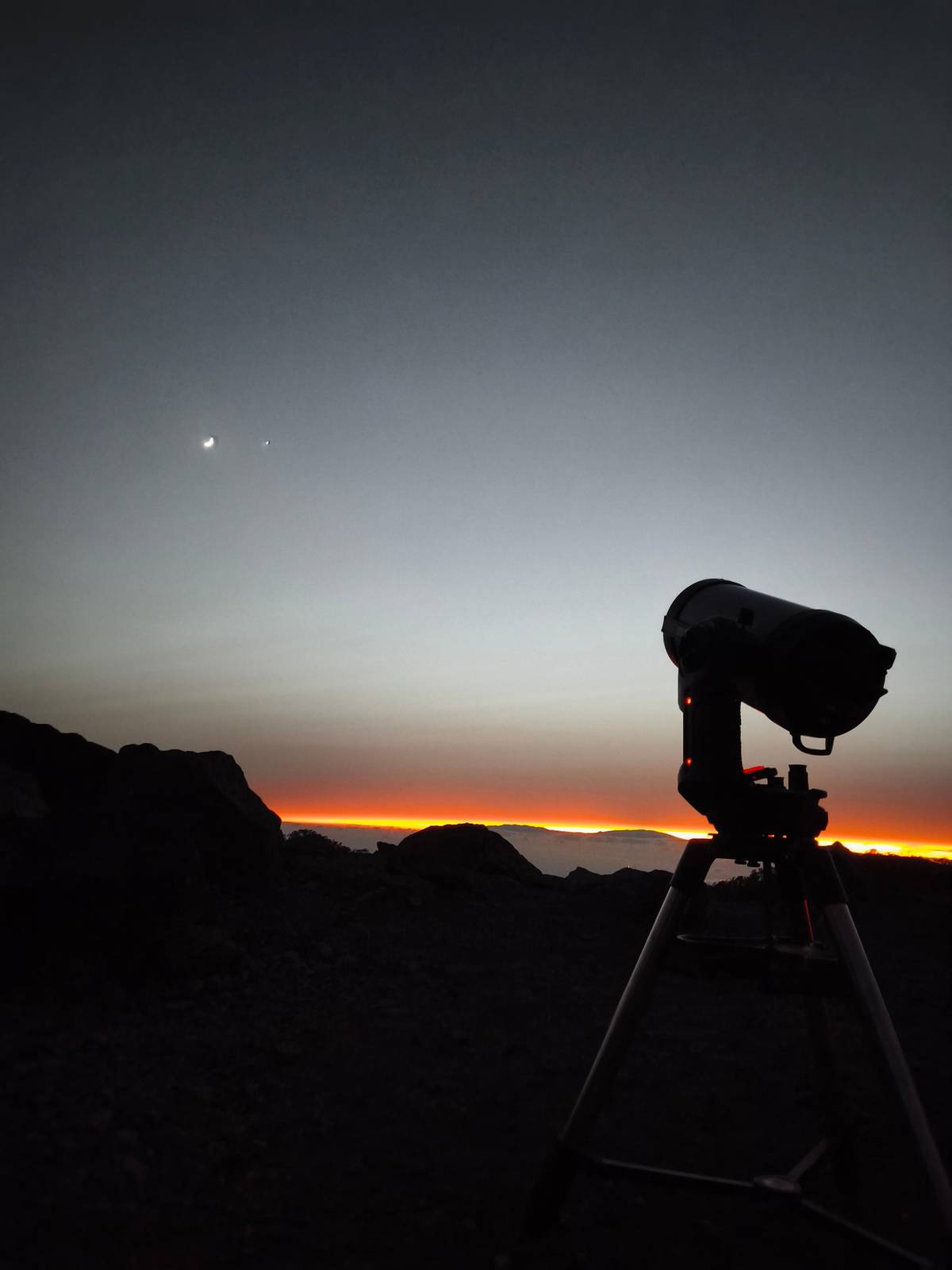
The show does not end when the sun disappears. The sky above the horizon keeps glowing orange and pink for a while, the cloud sea turns gray, and the first bright points appear overhead: often planets before stars. This is the moment many people put their phones away and simply watch. Look east as well as west: the shadow of the mountain and the darkening band of sky opposite the sunset are part of the spectacle, and they are easy to miss while everyone faces the sun.
Your eyes need time to catch up. The human eye takes 15 to 30 minutes to adapt to darkness, and any strong light, a torch or car headlights, resets the clock by another 15 minutes.15 Keep screens dim between the sunset stop and the stargazing stop, and you arrive at the telescope already seeing more.
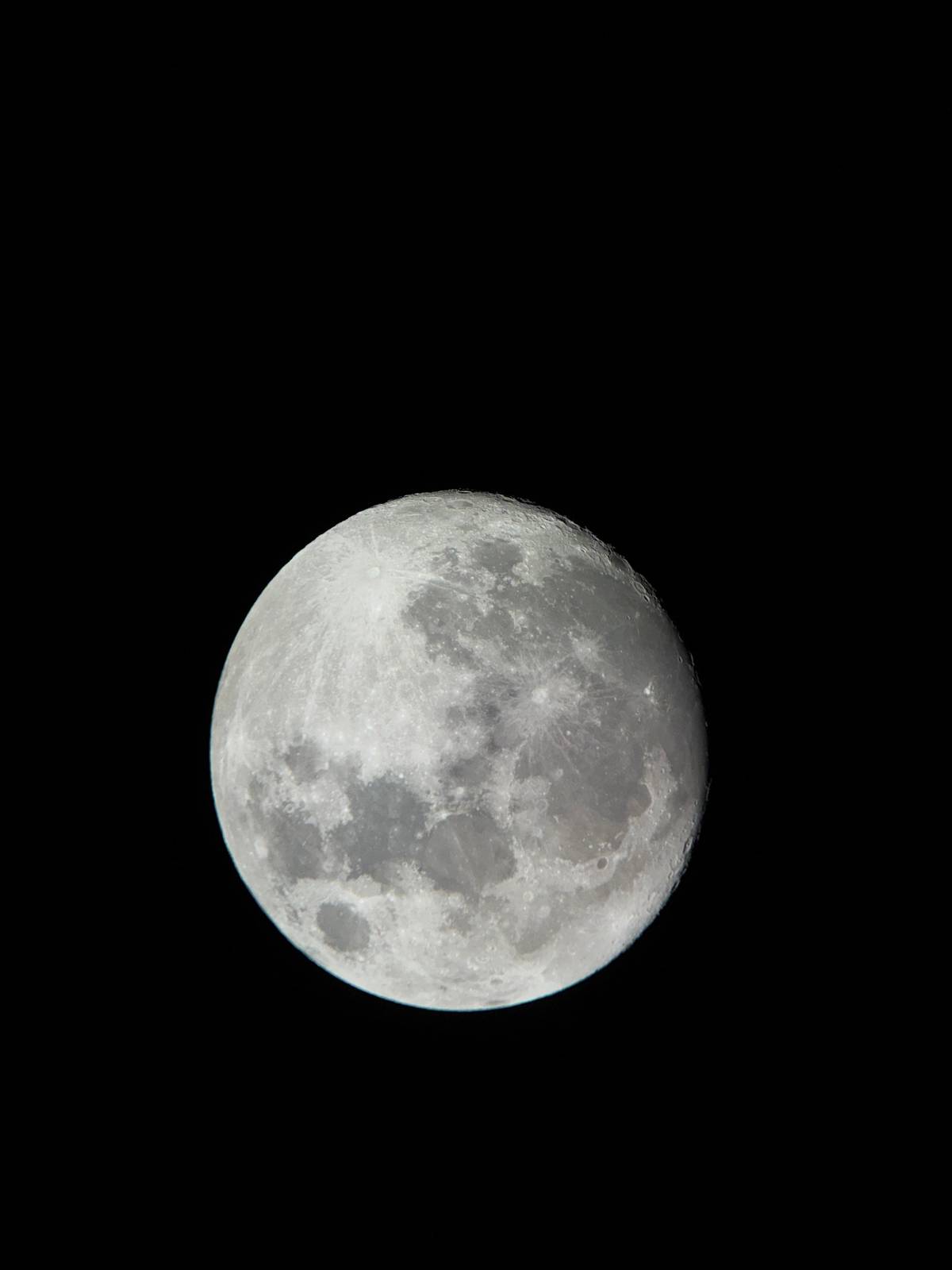
The Moon changes this part of the evening. A first quarter Moon rises around midday and sets around the middle of the night, so it hangs high and bright after sunset.16 A full Moon rises at sunset, which makes for a lovely moonrise over the clouds but a paler sky later on.17
Which months give the clearest evenings
High on the mountain, summer is the clearest season. AEMET's normals for its Izaña station, at 2,369 m beside the observatory, count an average of 27.0 cloudless days in July and 24.2 in August.1819 November and December average 9.4 and 10.8, so winter sunsets are more of a gamble.20
Day length shifts the timing of the whole evening. At Izaña the sun is above the horizon for about 13.9 hours in mid-June and about 10.4 hours in mid-December, by our own calculation.21 Summer pickups therefore leave later and finish later, while winter evenings start early and give you the longest dark sky.
The operator sends the exact pickup or meeting time by WhatsApp on the day, by the early afternoon, and that time replaces the generic one printed on your ticket. It follows the sunset, so do not plan dinner reservations around the time on your booking confirmation.
When wind and cold change the plan
A clear sky is not the only condition that counts. The park's climate is dry, with strong contrasts between day and night and often strong winds.22 Even in July the average low at Izaña is 14 °C, and in January it is 1.1 °C.21
On the evening booked here, the guides may decide to keep the group at the lower viewpoint for the stargazing if wind, cloud or cold make the upper one unsuitable. The sunset stop still happens. It is a sensible rule: a telescope that shakes in the wind shows less, and a group that is shivering does not enjoy what it sees.
Dress for the second half of the evening, not the first. The listing asks for warm clothing and shoes, a jacket, a long-sleeved shirt and long trousers, and warm jackets are lent on the VIP option. A thin layer that feels right while the sun is still out will not be enough long after dark.
Photographing the sunset over the clouds
Sunsets over a cloud sea are easier to photograph than they look. Expose for the bright sky, not for the ground, and let the mountains and people turn into silhouettes. A glass of Cava held up against the low sun is the classic shot from this viewpoint, and it costs nothing but a steady hand.
Wide lenses exaggerate the flatness of the cloud layer; a moderate zoom brings the distant islands closer and makes them look larger above the white. Take a few frames after the sun has gone, too: the colors often peak a few minutes later, when the clouds catch the glow from below the horizon.
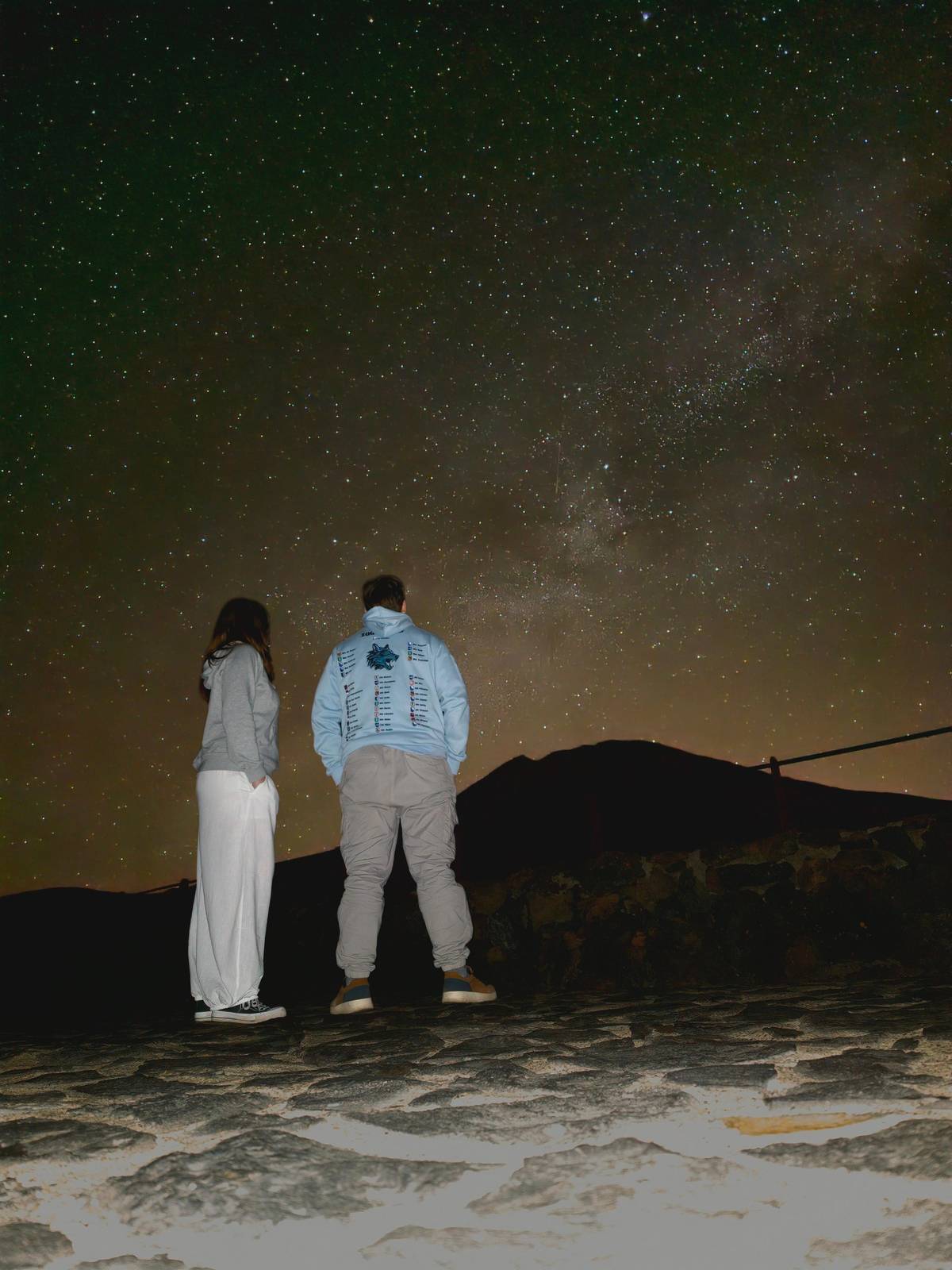
Then change your settings for the night. The evening booked here includes a photo of each guest taken with astrophotography techniques at the stargazing stop, so you do not have to master long exposures to leave with the stars on camera. Our page on photographing the Milky Way covers the rest.
Your night on Teide
Sunset with Cava, then the stars.
Hotel pickup in the south or your own car; choose an evening, and change your mind free until 24 hours ahead.


You ask,we answer.
What is the sea of clouds over Tenerife?
A layer of stratocumulus. The trade winds push it against the northern mountains, between 500 and 1,500 m.1
Where does the booked evening watch the sunset?
At a viewpoint at 1,400 m. Beside a lava flow, facing La Palma, La Gomera and El Hierro.
Is a drink included at sunset?
Yes, Cava or a soft drink. A glass of Cava or a non-alcoholic drink is included; food is not, so eat beforehand.
How long is the sunset stop?
45 minutes. With photos and a drink, then a 5-minute van ride to the stargazing viewpoint.
Can I watch the sunset from the cable car?
On one evening, yes. It rides up to 3,555 m; people with heart problems and pregnant women may not ride.
When are sunsets clearest on Teide?
In summer. Izaña averages 27.0 cloudless days in July, against 9.4 in November.1920
What if it is too windy after sunset?
The group stays lower down. The guides may keep the group at the lower viewpoint for the stargazing too.
Sources
Sources and evidence
- 1Turismo de Tenerife (webtenerife.co.uk, official tourism site)Blanket of cloud↩
- 2Turismo de Tenerife (webtenerife.co.uk, official tourism site)Blanket of cloud↩
- 3Ministerio para la Transición Ecológica (Red de Parques Nacionales)Parque Nacional del Teide↩
- 4Parque Nacional del Teide (Gobierno de Canarias)Accesos↩
- 5Parque Nacional del Teide (Gobierno de Canarias)Accesos↩
- 6Parque Nacional del Teide (Gobierno de Canarias)Centros y horarios↩
- 7Instituto de Astrofísica de Canarias (IAC)Teide Observatory↩
- 8Instituto de Astrofísica de Canarias (IAC)Teide Observatory↩
- 9Turismo de Tenerife (webtenerife.co.uk, official tourism site)The best places for stargazing in Tenerife↩
- 10Turismo de Tenerife (webtenerife.co.uk, official tourism site)Teide National Park↩
- 11Turismo de Tenerife (webtenerife.co.uk, official tourism site)The best places for stargazing in Tenerife↩
- 12Turismo de Tenerife (webtenerife.co.uk, official tourism site)The best places for stargazing in Tenerife↩
- 13Turismo de Tenerife (webtenerife.co.uk, official tourism site)The best places for stargazing in Tenerife↩
- 14Turismo de Tenerife (webtenerife.co.uk, official tourism site)The best places for stargazing in Tenerife↩
- 15Turismo de Tenerife (webtenerife.co.uk, official tourism site)Stargazing in Tenerife: Unique views of the sky↩
- 16NASA ScienceMoon Phases↩
- 17NASA ScienceMoon Phases↩
- 18AEMET (Spanish State Meteorological Agency)Standard climate values: Izaña (C430E), 1981-2010↩
- 19AEMET (Spanish State Meteorological Agency)Standard climate values: Izaña (C430E), 1981-2010↩
- 20AEMET (Spanish State Meteorological Agency)Standard climate values: Izaña (C430E), 1981-2010↩
- 21↩
- 22Ministerio para la Transición Ecológica (Red de Parques Nacionales)Parque Nacional del Teide↩